CULTURE / THE WAY WE WATCHED
2000s Pop Culture: From Burned CDs to YouTube
One decade held the mix CD, the iPod, the first YouTube upload and the beginnings of streaming. No wonder our memories of it overlap.
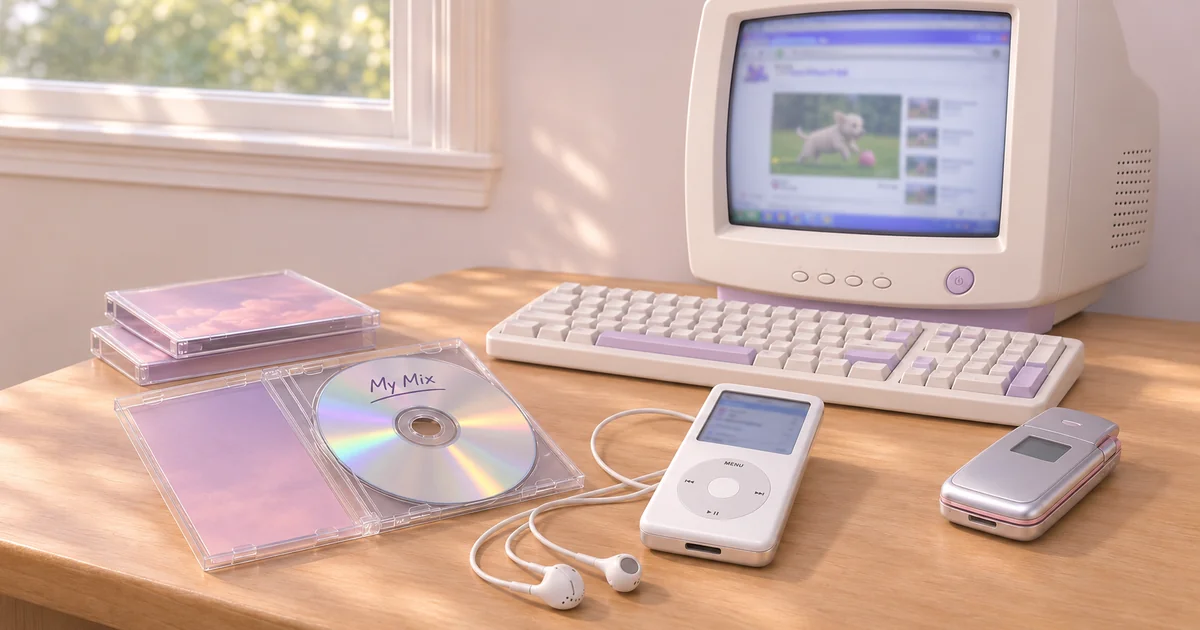
A homemade mix CD had a limited amount of space. Someone had to choose the songs, decide what opened the disc and write a title across the top. Even the order could mean something.
By the end of the 2000s, the ingredients of a different entertainment life were taking shape: videos you could upload yourself, films delivered over the internet and a phone that could carry much of it around.
Between those two pictures sits a decade of overlapping habits. You could watch Mean Girls on a disc, carry downloaded music on an iPod and send someone a YouTube link—all without feeling as though you had crossed into a new era.
That's a useful way to revisit 2000s pop culture. Follow the things people watched and listened to, then notice how the route to those things kept changing.
The iPod arrived before the music store
Apple introduced the first iPod in October 2001, advertising enough space for 1,000 songs. The iTunes Music Store followed in 2003. That order is easy to blur: the pocket-sized player was already around before Apple's download shop joined it.
In May 2003, Apple reported that the store had sold more than a million songs in its first week. Individual tracks cost 99 US cents. A song could be a small purchase of its own, separate from buying an entire album. Sources: Apple's original iPod announcement and first-week iTunes sales report.
There was still a collection to manage. Files had to get onto a computer, then onto the player. You might sort out an album title, change a playlist or decide which songs deserved to make the trip.
The object changed from a disc to a device, while the pleasure of assembling your own little library remained. A scratched CD and a carefully organized iPod can belong to the same person's nostalgia.
Mean Girls and Facebook belong to the same year
Mean Girls arrived in 2004, the year Facebook launched. Put those dates next to each other and a familiar decade starts looking different: Cady Heron's school cafeteria and an early college social network share a place on the timeline. Sources: Paramount's Mean Girls record and Meta's company history.
That doesn't mean everyone was using Facebook while the film was in theaters. Its original launch and its later availability to a wider public are separate milestones. A platform can exist for years before it becomes part of your own daily life.
This is one of the interesting traps in a pop-culture timeline. We tend to file things by when we encountered them. A film watched years later, a website joined at school and an album borrowed from a friend can end up in one mental folder, even when their beginnings are far apart.
The dates add a second story alongside the personal one.
YouTube made the link part of the entertainment
YouTube's first upload, “Me at the zoo,” appeared on April 23, 2005. Its modest subject—Jawed Karim talking about elephants—makes an unusually ordinary beginning for such a consequential platform. Source: YouTube's own account of its first video.
Here was another kind of thing to watch alongside television and films: a short clip someone had uploaded. Sending the link could become part of the experience. There was something to find, something to pass on and someone whose reaction you wanted to see.
Online video and amateur filmmaking already existed. YouTube became a place where those activities could meet around an easily shared page. A viewing recommendation no longer needed to be the name of a programme and a broadcast time; it could simply be a URL.
The distinction feels especially vivid beside the other entertainment of that year. The US version of The Office premiered in March 2005. A new network sitcom and YouTube's first upload were near-neighbours, even though one looks like a continuation of television history and the other like a beginning. Source: NBCUniversal's The Office history.
Disney Channel and Wii kept the living room busy
The middle of the decade also supplied experiences built around the television itself. High School Musical premiered on Disney Channel in January 2006. Nintendo launched Wii in 2006. Sources: Disney's High School Musical release record and Nintendo's official history.
One offered songs, characters and a school musical. The other brought a motion-sensitive controller into the room. They make an appealing pair because they suggest how varied entertainment at home could be: watching, singing along, taking turns and getting up from the sofa.
It's tempting to tell the decade as a straight march towards the internet. The living-room memories complicate that story. New websites were arriving while cable premieres, film discs and games consoles continued giving people reasons to gather around another screen.
In 2007, the phone and the film library started moving
Apple introduced the iPhone in 2007. Netflix also began streaming in 2007, following its earlier DVD business. Two developments that now seem to belong together started taking shape in the same year. Sources: Apple's iPhone anniversary history and Netflix's company retrospective.
Their launches didn't instantly create today's habits. An early service, a device's first release and widespread everyday use are different stages. The dates mark beginnings, with adoption and expansion still ahead.
Even so, the direction becomes visible. A phone could bring more kinds of media into one object. A film service could offer viewing without a disc arriving at the door. The relationship between entertainment and the physical things used to reach it was changing again.
For someone who remembers a shelf of DVDs, that shift can feel more revealing than another list of the decade's biggest films.
By 2008, another set of habits was waiting
Apple's App Store opened in July 2008 with 500 apps. Spotify launched in October 2008, initially in European markets. Its US launch came later, in 2011. Those geographic differences matter: a service's first year isn't necessarily the year it arrived where you lived. Sources: Apple's App Store history and Spotify's visual company timeline.
The 2000s ended with more ways to acquire software, reach a music catalogue and find a video. Alongside them were the things people already owned, kept, lent and replayed.
A mix CD didn't stop being meaningful because a new music service existed. A DVD could still be the easiest way to put on a favourite film. New habits arrived unevenly, leaving the decade full of combinations that make perfect sense in memory and look surprising on paper.
The rituals are part of the nostalgia
Viewed this way, 2000s nostalgia has room for the small tasks around entertainment: naming a playlist, choosing a ringtone, returning a disc, waiting for a programme or finding a clip worth sending to someone.
The songs and films matter. So do the earbuds, menus, cases and screens attached to them. They give a memory a setting.
That is what makes a 2000s pop culture timeline interesting beyond the dates. It shows how several versions of everyday life could fit inside ten years—and why a handful of familiar objects can bring back such different moments.
If you enjoy noticing those connections, PopLine's free daily game lets you put pop-culture moments in order. For another read, explore the pop-culture moments that happened in the same year, or browse the full article collection.